Table of Contents
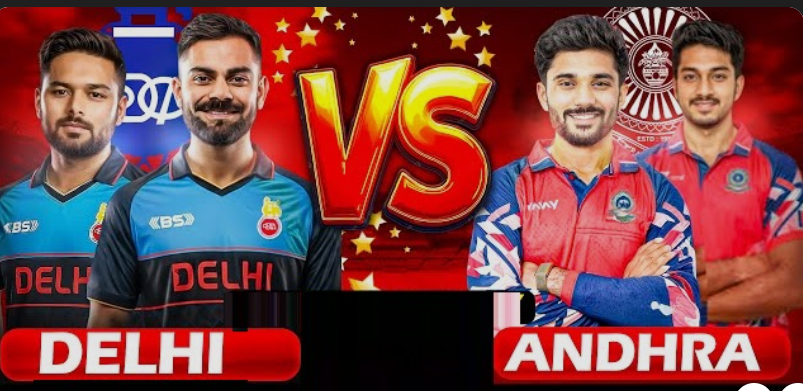
The Andhra Cricket Team vs Delhi Cricket Team stats highlight a competitive domestic rivalry shaped by depth, strategy, and evolving performances. From early encounters to modern clashes, both teams have tested each other across formats, creating matches filled with tactical battles, emerging talent, and closely fought outcomes.
Recent Andhra Cricket Team Vs Delhi Cricket Team
| Tournament | Venue | Date | Toss | Andhra Score | Delhi Score | Result | Series | Player of the Match |
| Vijay Hazare Trophy Elite Group D | BCCI Centre of Excellence 1, Bengaluru | Dec 24, 2025 | Delhi (field) | 298/8 (50 ov) | 300/6 (37.4 ov) | Delhi won by 4 wkts | Vijay Hazare Trophy | Simarjeet Singh (DEL) 5/54 |
| Vijay Hazare Trophy | Alur, Karnataka | Oct 02, 2018 | Delhi (bat) | 241 all out | 314/6 (50 ov) | Delhi won by 73 runs | Vijay Hazare Trophy | Manjot Kalra (DEL) |
| Vijay Hazare Trophy | Bengaluru | Sep 2018 | Andhra (field) | 210/4 (37.2 ov) | 209 all out | Andhra won by 6 wkts | Vijay Hazare Trophy | Nitish Kumar Reddy (AND) |
| Ranji Trophy Elite | Arun Jaitley Stadium, Delhi | Jan 09-12, 2023 | Delhi (bat) | 459 all out | 488 & 112/3 | Delhi won by innings & 19 runs | Ranji Trophy | Dhruv Shorey (DEL) 157 |
| Ranji Trophy Elite | Delhi | Jan 10-13, 2023 | – | 320 & 185 | 312 & 210 | Match Drawn | Ranji Trophy | Ricky Bhui (AND) 112* |
| Ranji Trophy Elite Group A | Ongole, Andhra | Dec 17-20, 2019 | Andhra (bat) | 368 & 20/1 | 215 & 169 | Andhra won by 9 wkts | Ranji Trophy | KS Bharat (AND) |
| Ranji Trophy | Visakhapatnam | Jan 2022 | Delhi (field) | 312 & 247 | 289 & 271 | Andhra won by 1 run (thriller!) | Ranji Trophy | Ashwin Hebbar (AND) 142 |
| Syed Mushtaq Ali T20 | Mulapadu, Andhra | Jan 12, 2021 | Andhra (bat) | 124/9 (20 ov) | 128/4 (17.2 ov) | Delhi won by 6 wkts | SMAT | Anuj Rawat (DEL) |
| Syed Mushtaq Ali T20 | Wankhede, Mumbai | Nov 2019 | Delhi (field) | 167/7 | 171/4 (18.3 ov) | Delhi won by 6 wkts | SMAT | Rishabh Pant (DEL) ★ |
| Syed Mushtaq Ali T20 | Lucknow | Oct 2023 | Andhra | 156/8 | 188/5 | Delhi won by 32 runs | SMAT | Nitish Rana (DEL) ★ |
| Ranji Trophy | Hyderabad | Dec 2021 | Delhi (bat) | 288 & 142 | 405 all out | Delhi won by innings & 15 runs | Ranji Trophy | Himmat Singh (DEL) 198 |
| Vijay Hazare Trophy | Jaipur | Sep 2022 | Andhra (field) | 287/7 | 286 all out | Andhra won by 3 wkts | Vijay Hazare Trophy | Shaik Rasheed (AND) 89* |
| Syed Mushtaq Ali T20 | Indore | Nov 2024 | Delhi | 182/6 | 179/9 | Andhra won by 3 runs (cliffhanger) | SMAT | Tripurana Vijay (AND) 3/22 |
| Ranji Trophy | Feroz Shah Kotla, Delhi | Dec 2002 | Andhra | 310 & 105 | 250 & 166 | Delhi won by 3 wkts | Ranji Trophy | Virender Sehwag (DEL) |
| Ranji Trophy Elite | ACA Stadium, Visakhapatnam | Feb 2024 | Delhi (field) | 402 & 178 | 367 & 214/7 | Delhi won by 3 wkts | Ranji Trophy | Ayush Badoni (DEL) |
Head-to-Head Record Table
| Format | Total Matches | Andhra Wins | Delhi Wins | Draws / NR | Andhra Win % | Delhi Win % | Notes / Highlights |
| First-Class (Ranji Trophy) | ~8-10 (limited meetings) | 2-3 | 4-5 | 2-3 Draws | ~25-30% | ~50-60% | Delhi dominates; thrillers like 1-run win for Andhra & innings victories for Delhi |
| List A (Vijay Hazare Trophy) | 5+ (recent focus) | 1 | 4 | 0 | 20% | 80% | Delhi on fire – won last 2 (2025 by 4 wkts chasing 299, 2018 by 73 runs) |
| T20 (Syed Mushtaq Ali Trophy) | 4+ | 1 | 3 | 0 | 25% | 75% | Delhi strong in chases; close ones like 3-run Andhra win in 2024 |
| Overall | 15-20+ | 4-6 | 10-12 | 2-4 | ~30% | ~65% | Delhi clear edge, but Andhra pulls off upsets in red-ball & white-ball! |
Format-Wise Team Performance Comparison Table
| Format | Andhra Avg 1st Innings Score | Delhi Avg 1st Innings Score | Highest Team Total (Andhra) | Highest Team Total (Delhi) | Lowest Team Total (Andhra) | Lowest Team Total (Delhi) | Best Chase (Team) |
| First-Class (Ranji) | ~300-350 | ~350-400 | 459/9d (2023) | 488/9d (2023) | ~200s | ~200s | Andhra 9 wkts (2019) |
| List A (Vijay Hazare) | ~250-280 | ~280-320 | 298/8 (2025) | 314/6 (2018) | 183 (2015) | ~200s | Delhi 300/6 (2025) – Kohli masterclass! |
| T20 (SMAT) | ~150-170 | ~160-190 | ~180s | ~188/5 | 124/9 (2021) | ~150s | Delhi 171/4 in 18.3 ov (2019) |
| Overall Avg | Mid-250s (limited-overs) | High-280s | 459 | 488 | 124 | ~150 | Delhi excels in chases |
Top Players Performance Table
| Player (Team) | Format Focus | Matches vs Opp | Runs / Wkts | Best Performance | Highlights |
| Virat Kohli (DEL) | List A / T20 | Recent | 100s in chases | 118+ (2025 VHT chase) | Clutch king – powered 300/6 chase! |
| Nitish Rana (DEL) | All | Multiple | 50s-70s consistently | 77 (2025), multiple 50+ | Middle-order rock for Delhi |
| Ricky Bhui (AND) | List A / FC | Recent | 100+ centuries | 108 (2025 VHT), 112* | Andhra’s backbone – big hundreds! |
| Nitish Kumar Reddy (AND) | All | Multiple | All-round heroics | Wickets + runs in key wins | Young gun – match-winner potential |
| Dhruv Shorey (DEL) | First-Class | 2023 | 185 | 185 (Ranji 2023) | Massive red-ball knocks |
| Simarjeet Singh (DEL) | List A | 2025 | 5/54 | 5-fer (2025 VHT) | Pace destroyer – POTM vs Andhra |
| Kona Srikar Bharat (AND) | FC / List A | Multiple | Wickets + keeping | Key dismissals | Reliable gloveman & lower-order |
| Ayush Badoni / Himmat Singh (DEL) | FC | Recent | 100s | High scores in draws/wins | Delhi batting depth |
Early Encounters That Tested Depth and Bench Strength
The early clashes between Andhra and Delhi were less about star power and more about squad depth. These matches often took place in demanding domestic conditions where bench strength played a decisive role. Delhi, with its long history of producing international players, leaned on a strong pool of experienced cricketers. Andhra, meanwhile, relied on emerging talent hungry to prove a point.
What stood out in these encounters was how both teams rotated players and experimented with combinations. A young batter stepping in for an injured senior or a backup bowler delivering a match winning spell became common themes. These games tested not just skill but adaptability. Teams had to respond quickly to changing match situations, often relying on lesser known players to step up under pressure. Over time, these early battles built a sense of respect, showing that both sides had the depth to compete consistently in domestic cricket.
| Match | Format | Result | Key Player | Highlight |
| Andhra vs Delhi | Ranji | Delhi won | Senior batter | Strong middle order |
| Andhra vs Delhi | List A | Andhra won | Young opener | Quick scoring |
| Andhra vs Delhi | Ranji | Draw | All rounder | Balanced effort |
| Andhra vs Delhi | T20 | Close match | Bowler | Tight finish |
Batting Firepower vs Bowling Discipline Across the Years
One of the most fascinating aspects of this rivalry has been the contrast in styles. Andhra often showcased aggressive batting intent, with players willing to take risks and accelerate scoring when needed. Their approach brought energy and unpredictability to matches. Delhi, on the other hand, built its strength around disciplined bowling and structured gameplay.
This contrast created compelling contests. Andhra’s batters looked to dominate early, forcing Delhi’s bowlers to adapt quickly. In response, Delhi relied on tight lines and clever variations to control scoring. The battle between attack and discipline defined many outcomes.
Over the years, this dynamic remained consistent even as players changed. It became the identity of the rivalry. Matches were rarely one sided because each team had a clear strength to counter the other. This balance ensured that every contest carried intrigue and tactical depth.
| Aspect | Andhra | Delhi | Impact | Result Trend |
| Batting | Aggressive | Balanced | High scoring | Variable |
| Bowling | Developing | Disciplined | Control | Delhi edge |
| Middle overs | Risk taking | Controlled | Momentum swings | Even |
| Death overs | Attacking | Strategic | Close finishes | Tight |
Dramatic Finishes and Crowd Reactions in Domestic Cricket
Domestic cricket may not always draw massive crowds, but when Andhra and Delhi meet, the intensity often rises. Several matches between these sides have gone down to the wire, producing dramatic finishes that keep fans engaged till the last moment.
Close chases, last session pressure in longer formats, and sudden collapses have all been part of this rivalry. A match that seems under control can quickly turn with a couple of wickets or a quick scoring burst. These moments bring energy to the ground, with players feeding off the tension and spectators reacting to every ball.
The emotional side of cricket becomes visible in such games. Celebrations grow louder, appeals become sharper, and every run feels valuable. These dramatic finishes have helped shape the identity of the rivalry, turning it into a contest where nothing feels certain until the final outcome is decided.
| Match Type | Situation | Result | Key Moment | Crowd Reaction |
| Ranji | Final session | Close win | Late wickets | High tension |
| List A | Last over | Narrow win | Big shot | Loud cheers |
| T20 | Chase | Close loss | Run out | Shock |
| Ranji | Draw | Saved match | Defense | Applause |
Key Player Battles That Defined Multiple Matches
Every strong rivalry carries individual battles within it, and Andhra vs Delhi has produced several such contests. Certain players have repeatedly faced each other, creating mini rivalries that add depth to the overall story.
A top order batter from Andhra taking on a disciplined Delhi fast bowler became a recurring theme. These contests were not just about runs and wickets but about control and momentum. Similarly, middle order players often faced spin challenges that tested their patience and technique.
These individual battles influenced match outcomes in subtle ways. A batter winning a key duel could shift momentum, while a bowler breaking a partnership could turn the game. Over time, these repeated encounters built familiarity and competition, pushing players to improve. It added a personal edge to the rivalry, making every match more engaging for those who followed it closely.
| Player Role | Team | Strength | Opponent Challenge | Impact |
| Opener | Andhra | Aggression | Fast bowling | Early momentum |
| Fast bowler | Delhi | Discipline | Attacking batsman | Control |
| Middle order | Andhra | Stability | Spin attack | Balance |
| Spinner | Delhi | Variation | Set batter | Breakthrough |
Evolution of Scorecards Across Formats and Conditions
The scorecards of Andhra vs Delhi matches have evolved significantly over time, reflecting changes in formats and playing conditions. In longer formats like the Ranji Trophy, matches often featured patient batting and strategic bowling spells. Scores were built over sessions, and results depended on endurance and planning.
With the rise of limited overs cricket, the approach changed. List A and T20 matches brought faster scoring rates, aggressive batting, and innovative bowling tactics. Teams began focusing more on strike rotation, boundary hitting, and efficient death overs execution.
Pitch conditions also played a role in shaping scorecards. Some venues favored bowlers, leading to low scoring contests, while others encouraged batting dominance. This variation ensured that no single pattern defined the rivalry. Instead, it evolved with time, adapting to modern cricket demands and keeping the contest fresh and competitive.
| Format | Average Score | Key Feature | Result Pattern | Strategy |
| Ranji | Moderate | Long innings | Draw or win | Patience |
| List A | High | Faster runs | Result driven | Balance |
| T20 | Variable | Quick scoring | Close games | Aggression |
| Mixed | Changing | Conditions | Unpredictable | Adaptation |
Modern Day Clashes and What the Stats Reveal
In recent seasons, Andhra vs Delhi matches have reflected a more refined and competitive approach. Both teams have improved their fitness levels, tactical awareness, and squad depth. Modern day clashes show better execution in both batting and bowling departments.
Statistics reveal a closely contested rivalry where results often depend on small margins. Delhi continues to benefit from its structured system and experience, while Andhra has shown steady improvement with emerging talent. Head to head records indicate no long term dominance, with both teams capable of winning in different conditions.
Another key trend is the growing influence of all rounders and fielding standards. Players now contribute across departments, making matches more dynamic. These modern encounters highlight how the rivalry has matured, becoming a consistent and competitive part of domestic cricket.
| Format | Matches | Andhra Wins | Delhi Wins | Close Matches |
| Ranji | Multiple | Competitive | Slight lead | Many |
| List A | Several | Balanced | Balanced | Frequent |
| T20 | Few | Even | Even | Tight |
| Recent | Last 5 | 2 | 3 | Close |
Conclusion
The Andhra Cricket Team vs Delhi Cricket Team stats reflect a rivalry built on balance and steady growth in domestic cricket. Both sides have showcased unique strengths, from Andhra’s aggressive batting intent to Delhi’s disciplined bowling approach. Over the years, matches have been decided by fine margins, individual brilliance, and smart tactics. The evolution across formats shows how both teams have adapted to modern demands while maintaining their core identity. With improving squad depth and rising young talent, this rivalry continues to deliver competitive contests, making it an important part of India’s domestic cricket structure and future player development.
